Why traditional staff augmentation fails and how capability-led scaling drives real outcomes
Why traditional staff augmentation fails and how capability-led scaling drives real outcomes
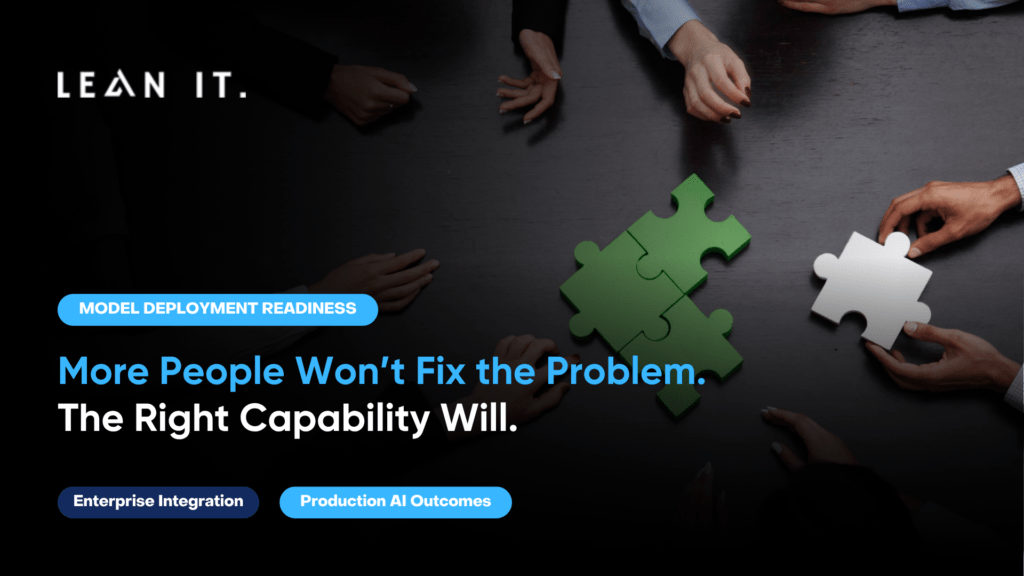
Staff augmentation has long been the default response to growing technology demands. When delivery timelines tighten or internal teams reach capacity, organizations bring in external talent to bridge the gap.
On the surface, this approach appears logical.
More people should mean faster execution.
However, in many enterprises, the results tell a different story.
Despite increasing team size, delivery timelines remain unchanged, quality issues persist, and operational complexity continues to grow. The assumption that additional resources automatically translate into better outcomes often proves to be flawed.
The issue is not the number of people.
It is the absence of the right capabilities aligned to the right problems.
Traditional staff augmentation models focus primarily on filling roles rather than solving challenges. Resources are onboarded based on technical skillsets, but without sufficient context of business objectives, system architecture, or execution priorities. As a result, teams expand but alignment does not.
This creates inefficiencies that compound over time.
New resources require ramp-up time, existing teams invest effort in coordination, and knowledge gaps begin to surface across functions. Instead of accelerating delivery, the system becomes heavier and more difficult to manage.
The impact becomes increasingly visible:
- Delivery velocity does not improve despite larger teams
- Knowledge silos emerge across internal and external resources
- Quality inconsistencies increase due to fragmented ownership
- Leadership spends more time managing teams than driving outcomes
At this stage, organizations often find themselves caught in a cycle—adding more people to solve problems created by adding people.
Breaking this cycle requires a shift from resource-based scaling to capability-based scaling.
This is where AI is beginning to redefine how workforce augmentation is approached.
AI enables organizations to better understand capability gaps, predict resource requirements, and align talent with outcomes more precisely. Instead of reacting to immediate needs, enterprises can proactively build teams that are optimized for performance.
AI-driven augmentation models can support:
- Intelligent skill-to-requirement mapping based on project context
- Predictive workforce planning aligned to delivery pipelines
- Continuous performance insights to optimize team composition
- Faster onboarding through knowledge augmentation and automation
However, technology alone is not enough.
At Lean IT, the focus is on delivering outcome-aligned augmentation rather than role-based staffing. In one enterprise engagement, an organization struggling with delayed project timelines had significantly expanded its team but continued to face execution challenges.
By redefining the augmentation model around capabilities combining specialized talent with AI-driven insights and structured execution frameworks the organization was able to realign its delivery engine. Teams became more focused, collaboration improved, and execution timelines were significantly reduced.
The shift was not about increasing capacity.
It was about increasing effectiveness.
This reflects a broader evolution in how enterprises should think about scaling. The future of work is not defined by how many people you have, but by how intelligently you deploy capability.
Because in complex environments, efficiency does not come from adding more resources.
It comes from adding the right ones at the right time, with the right context.
Are you scaling your teams or scaling your ability to deliver outcomes