




Oracle ERP & Cloud: The Complete
Enterprise Guide to AI & Implementation

An unfiltered guide to Oracle ERP and Oracle Cloud (OCI, Fusion Cloud, NetSuite) architecture,
embedded AI, licensing realities, and the implementation pitfalls vendors don't advertise.

Every Oracle sales deck tells you the same story: unified cloud, embedded AI, seamless modules, lower TCO.

What it doesn't tell you is which module dependencies will blow your timeline, which "AI-powered" features are still maturing, or why so many Oracle ERP implementations run 30–50% over budget.

This guide is written for buyers who are past the pitch and into the evaluation CIOs, ERP selection committees, and IT leaders comparing Oracle against SAP, Workday, or Microsoft Dynamics. It covers Oracle's actual architecture, where AI genuinely adds value versus where it's marketing gloss, and the operational truths that only surface once you're mid-implementation.

Understanding the Oracle Portfolio

Oracle's ERP and cloud offering isn't one product, it's a portfolio, and picking the wrong entry point is the single most common early mistake buyers make.

Oracle Fusion Cloud ERP

Oracle's flagship SaaS ERP, built cloud-native. It covers financials, procurement, project management, risk management, and supply chain. Fusion is Oracle's answer to the modern, continuously-updated SaaS model quarterly releases, no forced multi-year upgrade cycles, and a common data model across modules.

Oracle NetSuite

Positioned for mid-market and fast-growing companies. NetSuite is a separate codebase and architecture from Fusion; this matters because Oracle sometimes blurs the line in sales conversations. If you're a $50M–$1B revenue company, NetSuite is usually the more realistic fit; Fusion is built for large, complex, multi-entity enterprises.

Oracle E-Business Suite (EBS) and JD Edwards

Still widely deployed and supported, but firmly legacy in Oracle's roadmap language. If you're on EBS or JDE, the decision isn't "should we modernize" it's "lift-and-shift to OCI, or re-platform onto Fusion." These are fundamentally different projects with different risk profiles, and vendors often present them as a simple upgrade when they are not.

Oracle Cloud Infrastructure (OCI)

The underlying infrastructure layer computes storage, the AI substrate. OCI matters even if you never touch it directly, because Fusion Cloud ERP runs on it, & Oracle's AI capabilities are tied to OCI's data. The decision-guide takeaway: before comparing Oracle to competitors, decide which Oracle you're actually evaluating

Architecture What's Actually Under the Hood

A Genuinely Unified
Data Model

Fusion Cloud ERP's shared data model unifies finance, HCM, and supply chain, but full integration is achieved only when multiple modules are implemented together.

Multi-Tenant SaaS, With
Configuration Limits

Fusion Cloud ERP reduces IT overhead with Oracle-managed updates, but migrating from customized on-premise systems requires re-engineering.

Quarterly Release
Cadence

Fusion Cloud ERP delivers quarterly updates, but organizations need ongoing regression testing and dedicated QA to stay current and avoid delays.

Integration Layer:
OIC

Oracle Integration Cloud securely connects Fusion with third-party systems, but its licensing cost is often overlooked during ERP
planning.

The Implementation Truths No
One Puts in a Brochure

A Practical Evaluation Framework

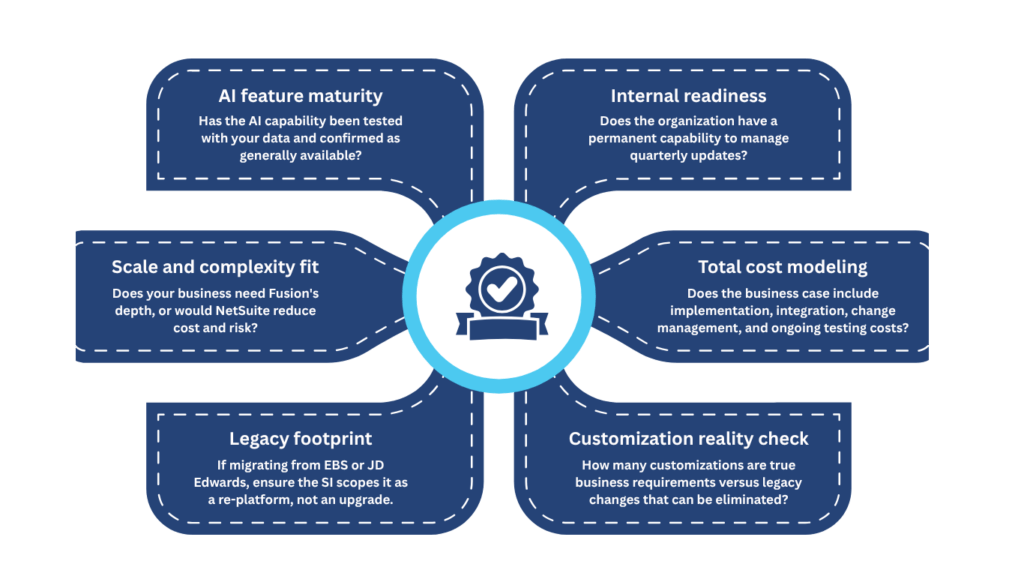
When comparing Oracle against alternatives, or comparing Oracle products against each other, structure the evaluation around these questions:

Making the Decision With Eyes Open

A guide for CIOs and IT leaders comparing Oracle with SAP, Workday, and Microsoft Dynamics covering architecture, AI, and implementation realities.

Oracle's ERP and cloud portfolio is mature, genuinely differentiated by its unified data model and infrastructure integration, and increasingly strengthened by embedded AI where that AI is production-proven. None of that changes the fact that implementation outcomes are determined more by data readiness, change management discipline, and systems integrator quality than by the software itself.

The organizations that succeed with Oracle ERP are the ones that budget for the real project not the brochure version of it. Use this guide as a starting framework for your own evaluation, and push every vendor and SI conversation toward specifics: named release versions, live demos against your data, and referenceable customers in your industry and size range.

This page is part of the Oracle Knowledge Center library. For related deep-dives, see: Oracle Fusion Cloud vs. SAP S/4HANA, Oracle NetSuite Implementation Timelines, and OCI AI Services Explained