


Cloud That Pays for Itself: The Enterprise Guide
to AWS, Cost Intelligence & AI Operations

AWS helps enterprises optimize cloud costs, improve visibility, and
drive smarter AI-powered operations.

Every enterprise IT leader knows the feeling. The migration business case looked airtight. The projected savings were real. And then, eighteen months in, someone in Finance forwards a cloud invoice with a subject line that just says "???"

This is not a technology failure. AWS is, by any measure, a mature and capable platform. What fails is the discipline around it the absence of a system that connects technical decisions to financial outcomes in real time, before the bill arrives rather than after. This guide is written for enterprise IT leaders, cloud architects, and the finance partners who sit across the table from them, and it lays out a practical framework for making AWS spend defensible, predictable, and genuinely value-generating.

Why Cloud Bills Outgrow
Cloud Value

Cloud costs rarely explode because of one bad decision. They creep, and they creep for a small number of very predictable reasons.

Always paying for peak

Infrastructure is sized for peak demand but runs 24/7, wasting resources.

Orphaned resources

Unused EBS volumes, load balancers, and snapshots quietly pile up.

Architectural inertia

Lift-and-shift workloads miss modern cloud optimization.

No team cost ownership

Centralized billing reduces team cost accountability.

Reactive cost governance.

Cloud spending is reviewed too late to prevent overspending.

The organizations that get cloud economics right treat cost as a first-class engineering metric, monitored with the same rigor as latency or uptime, not as a finance afterthought.

The Case for Cost Intelligence
Not Just Cost Reporting

"Cost reporting" tells you what happened. "Cost intelligence" tells you why it happened, what it means, and what to do next ideally before the spend lands on an invoice.

The distinction matters because most enterprises already have reporting. AWS Cost Explorer, Cost and Usage Reports, and a dozen third-party dashboards can all tell a CFO what was spent last month, broken down by service and account. What they can't always do on their own is connect that number to a business outcome, flag an anomaly while it's still small, or recommend the specific corrective action an engineering team should take on a Tuesday afternoon.

Attributes spend to
business context

Every dollar is tagged to a product line, customer segment, or business initiative, enabling leaders to track feature costs accurately.

Detects anomalies in
near real time

Rather than waiting for a monthly review, automated anomaly detection flags a spending spike within hours, while the underlying cause is still fresh and cheap to fix.

Forecasts forward,
not just backward

Good cost intelligence projects future spend based on current trends and planned initiatives, giving Finance a forecast they can plan against.

Recommends action,
not just observation

The best systems don't stop at "22% over budget"; they identify the specific instances, volumes, or queries responsible and suggest a remediation path.

The Case for Cost Intelligence
Not Just Cost Reporting

Where AI Changes the
Cloud Operations Equation

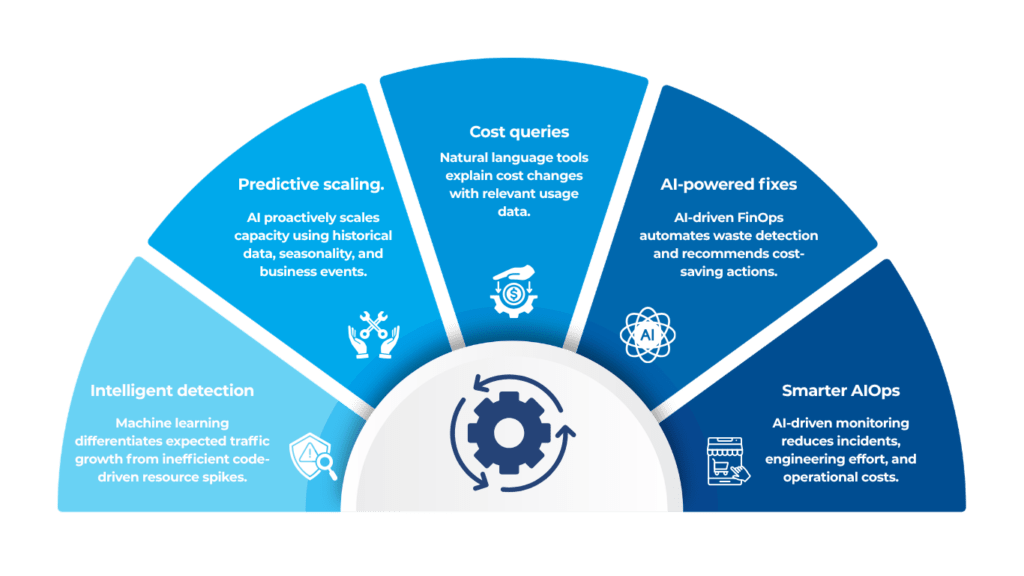
Generative and predictive AI are reshaping cloud operations in ways that go beyond the "AI-powered dashboard" marketing language that has flooded the FinOps space.

The caution worth building in here: AI-driven recommendations are only as trustworthy as the data and governance behind them. Enterprises that get the most value from AI-driven cloud operations pair these tools with strong tagging discipline and clear accountability AI accelerates good practice, but it doesn't substitute for it.

Building a Cost Intelligence
Operating Model

A tagging and account structure that reflects the business, not just the org chart. If cost data can't be sliced by product, customer segment, or initiative, no amount of tooling will make the numbers meaningful to business stakeholders.

Shared accountability between engineering and finance often called FinOps. The most effective model gives engineering teams visibility into and responsibility for the cost of what they build, while finance provides the forecasting rigor and business context. Neither side owns this alone.

A regular cadence, not a quarterly fire drill. Weekly or biweekly reviews of spend against forecast, paired with monthly business reviews that connect spend to outcomes, catch drift long before it becomes a budget crisis.

Guardrails that prevent waste rather than just reporting on it. Budget alerts, mandatory tagging policies enforced at deployment time, and automated lifecycle policies for storage and snapshots stop cost leakage at the source instead of relying on someone to notice it later.

Making the Case to the CFO

When a CIO needs to defend cloud spend to a CFO, the strongest arguments are rarely about the sticker price of AWS versus a data center.

They're about three things: predictability, attribution, and trend. Can the organization forecast next quarter's cloud spend within a reasonable margin? Can every material cost be tied to a business outcome or initiative, rather than sitting in an unallocated bucket? And is the trend line moving in the right direction relative to the business it supports is cost per transaction, per customer, or per unit of output improving over time, even if total spend is growing alongside a growing business?

A CFO who sees clear, defensible answers to those three questions is far more likely to trust the next cloud investment than one who receives a bill and a shrug. This is the practical meaning of "cloud that pays for itself" not that cloud is free, but that its cost is understood, governed, and visibly connected to the value it creates.

Cost Predictability

Cost Attribution

Trend Analysis

Business Value

Cloud Governance