Nearly every large enterprise has an AI pilot to show for its efforts. Fewer have a production system that moved the P&L. Somewhere between the proof-of-concept demo and the quarterly business review, most AI initiatives quietly stall not because the model didn't work, but because the organization around it wasn't built to absorb it.
This is the pilot trap: a cycle of promising experiments that never graduate into core operations. Data science teams build something impressive in a sandbox. Business leaders nod along in a demo. Then the project sits in limbo too risky to scale without more governance, too expensive to scale without a clearer business case, and too disconnected from existing systems to scale without significant rework.
For CIOs, CDOs, and COOs, this is no longer an abstract concern. Boards are asking pointed questions about AI spend and AI returns, and "we're still piloting" is not an answer that survives a second year. This guide is written for leaders who are done experimenting and ready to execute covering how to move beyond the pilot, how to embed intelligence into the operational fabric of the business, and how to measure ROI in terms a board will actually trust.
Why Pilots Stall: The Four Failure Patterns
Before fixing the problem, it's worth naming why it happens. Across enterprises, four patterns explain most stalled AI initiatives.
The pilot was designed to impress, not to integrate
Many AI pilots are isolated from core business systems, proving concepts but not real-world business integration.
Ownership sits with the wrong function
AI initiatives fail to scale when business teams aren't involved in owning and integrating the outcomes.
Built on projected value, not baseline metrics
AI pilots often rely on projected efficiency gains instead of measurable results against a clear baseline.
Governance was an afterthought
Poor data quality, weak governance, and security gaps often delay AI scaling until compliance issues are resolved.
Phase 1: Moving Beyond the Pilot
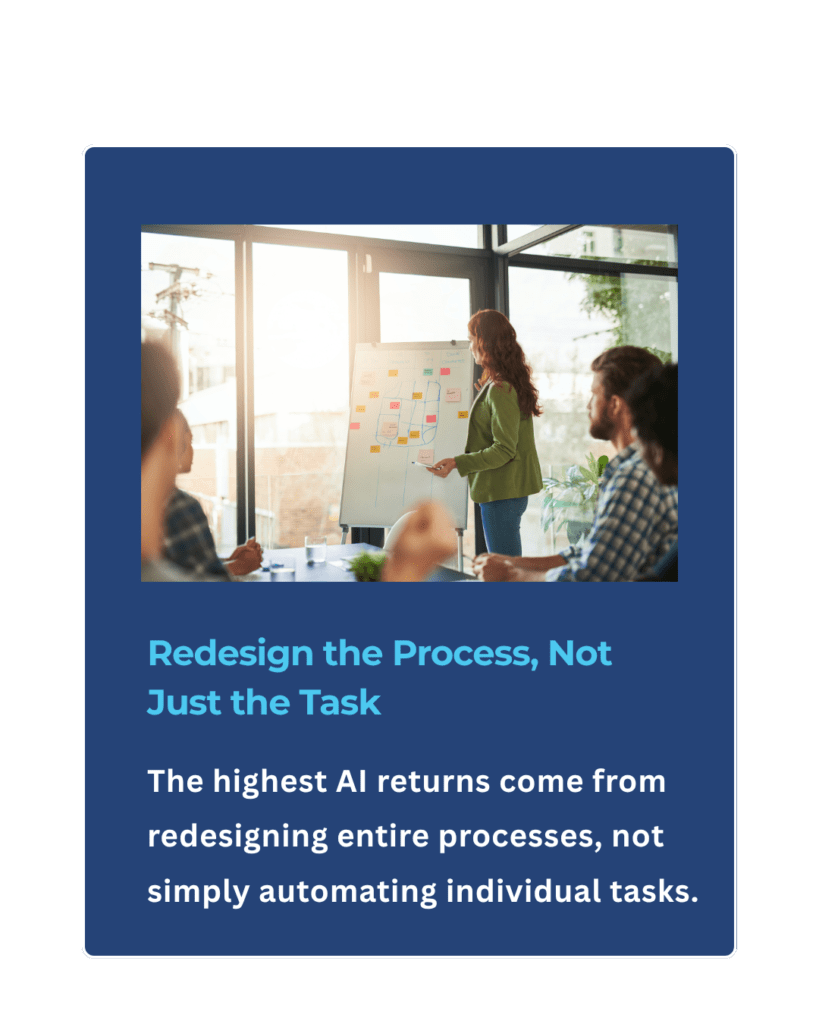
Anchor to a Business Process, Not a Use Case
Reframe AI initiatives around measurable business processes such as order-to-cash, procure-to-pay, forecast-to-plan, or hire-to-retire instead of generic use cases.
Business processes have clear owners, measurable KPIs, making AI easier to scale and measure.
Build on Your System of Record, Not Beside It
AI scales better when embedded in ERP and core business systems, reducing duplicate data pipelines, security models, and integration complexity.
This enables faster deployment and smoother scaling across enterprise workflows.
Establish a Scaling Gate, Not Just a Pilot Review
Enterprises rarely arrive at operational excellence in one step. A practical adoption sequence looks like this:
Foundation: Establish landing zones, identity governance, and network topology before migrating workloads.
Migration: Move workloads in phases, prioritizing business risk and technical complexity.
Optimization: Apply Well-Architected Reviews, tagging, and cost governance as the environment grows.
AI Enablement: Deploy AI on a secure, well-governed infrastructure.
Continuous Operations: Continuously improve FinOps, security, and reliability.
Sequence for Momentum
Rather than attempting an enterprise-wide rollout, sequence AI deployment by starting with the process that has the cleanest data, the most engaged process owner, and the clearest, most measurable financial impact.
An early, visible win even a modest one builds the internal credibility needed to fund the next ten initiatives.
Phase 2: Measuring ROI the Board Actually Believes
Boards trust AI ROI when efficiency, effectiveness, and growth metrics are measured separately against clear baselines.
Transparent assumptions and measurable outcomes make ROI claims more credible and defensible.
Baseline Before Deployment
Set a clear baseline before deployment to accurately measure ROI and business impact.
Report ROI in Financial Terms
Boards need cost savings, revenue impact, risk reduction not technical metrics
Track Total AI Cost
Credible ROI includes deployment, integration,and ongoing operational costs.
Maintain an AI Value Ledger
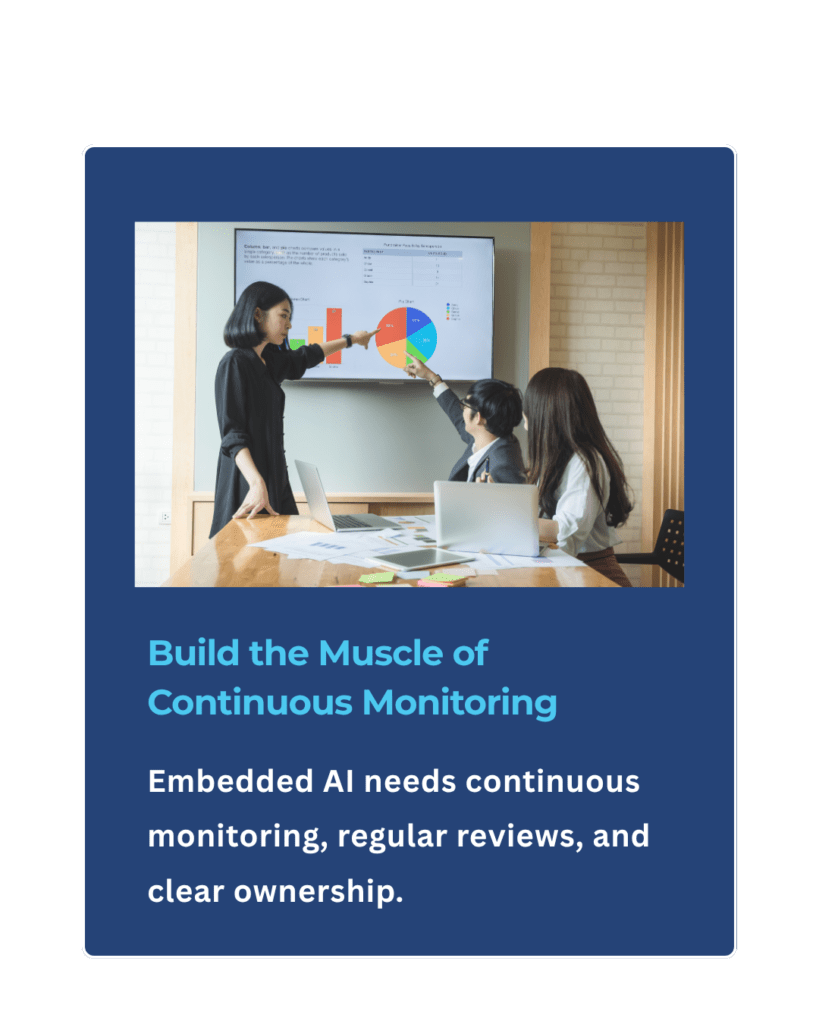
Track AI baselines, and financial impact to demonstrate sustained business value.
Phase 3: Embedding Intelligence Across Operations
Once an initiative clears the scale gate, the challenge shifts from "does this work" to "does this become how we normally operate."